1. The Dawn of Memory Research
The Dawn of Memory Research. Hermann Ebbinghaus, a pioneering German psychologist, initiated the scientific study of memory in the late 19th century. His groundbreaking experiments, conducted on himself, laid the foundation for understanding how we learn and forget. Ebbinghaus aimed to quantify memory by using himself as the subject, memorizing lists of nonsense syllables (consonant-vowel-consonant combinations like 'DAX' or 'QEH') to isolate the process from prior knowledge. This departure from introspective methods represented a significant methodological advancement in psychology.
2. The Forgetting Curve Concept
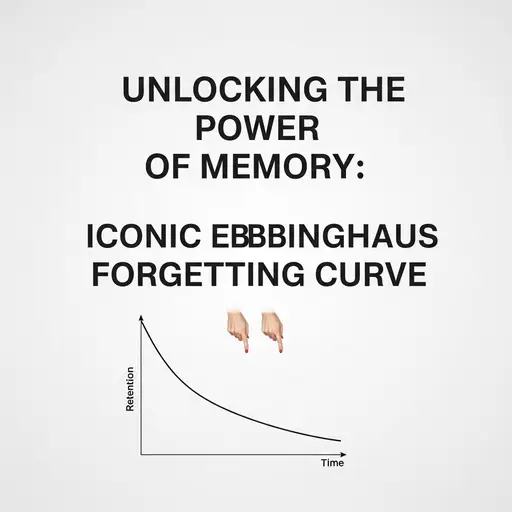
The Forgetting Curve Concept. Ebbinghaus's most famous contribution is the 'forgetting curve,' a graphical representation depicting the decline of memory retention over time. He observed that information is lost at an exponential rate when there is no attempt to reinforce or recall it. This curve demonstrates that we forget most of the information shortly after learning it, with the rate of forgetting slowing down over extended periods. Understanding this natural decay is crucial for designing effective learning schedules.
3. Exponential Memory Decay
Exponential Memory Decay. The curve illustrates an exponential loss of information, meaning the amount of information forgotten is proportional to the amount of information remaining. Initially, recall drops sharply, but over longer durations, the rate of forgetting diminishes. This pattern highlights the critical importance of immediate review and spaced repetition to combat natural memory attrition and solidify learning in long-term storage.
4. The Role of Meaningful Content
The Role of Meaningful Content. While Ebbinghaus used nonsense syllables to isolate memory, his work implicitly suggests that meaningful content is easier to retain. Information that can be connected to existing knowledge, organized logically, or made personally relevant is less susceptible to the forgetting curve. This principle underpins many modern learning techniques that emphasize context and association.
5. The Power of Spaced Repetition
The Power of Spaced Repetition. To counteract the forgetting curve, Ebbinghaus identified the effectiveness of 'spaced repetition.' By reviewing material at increasing intervals, learners can significantly improve retention. This method involves revisiting information just before it's likely to be forgotten, thereby strengthening the memory trace and moving it towards more durable long-term storage. This is a cornerstone of efficient learning.
6. Relearning and Memory Savings
Relearning and Memory Savings. Ebbinghaus also observed that relearning previously forgotten material takes less time and effort than learning it for the first time. He termed this 'memory savings.' The more times a piece of information is learned and recalled, the stronger its memory representation becomes, and the less time is needed for subsequent relearning, demonstrating the cumulative effect of practice.
7. Practical Applications in Education
Practical Applications in Education. The Ebbinghaus forgetting curve has immense practical value in educational settings and personal learning. Educators and students can use its principles to structure study schedules, design curricula, and optimize recall for exams. Understanding when to review material ensures that learning efforts are not wasted due to forgetting, leading to more efficient and effective knowledge acquisition.