 

The Four Jhanas - List

  5.00/5.00 - (1 votes for article, provide comments and help us improve if required.)

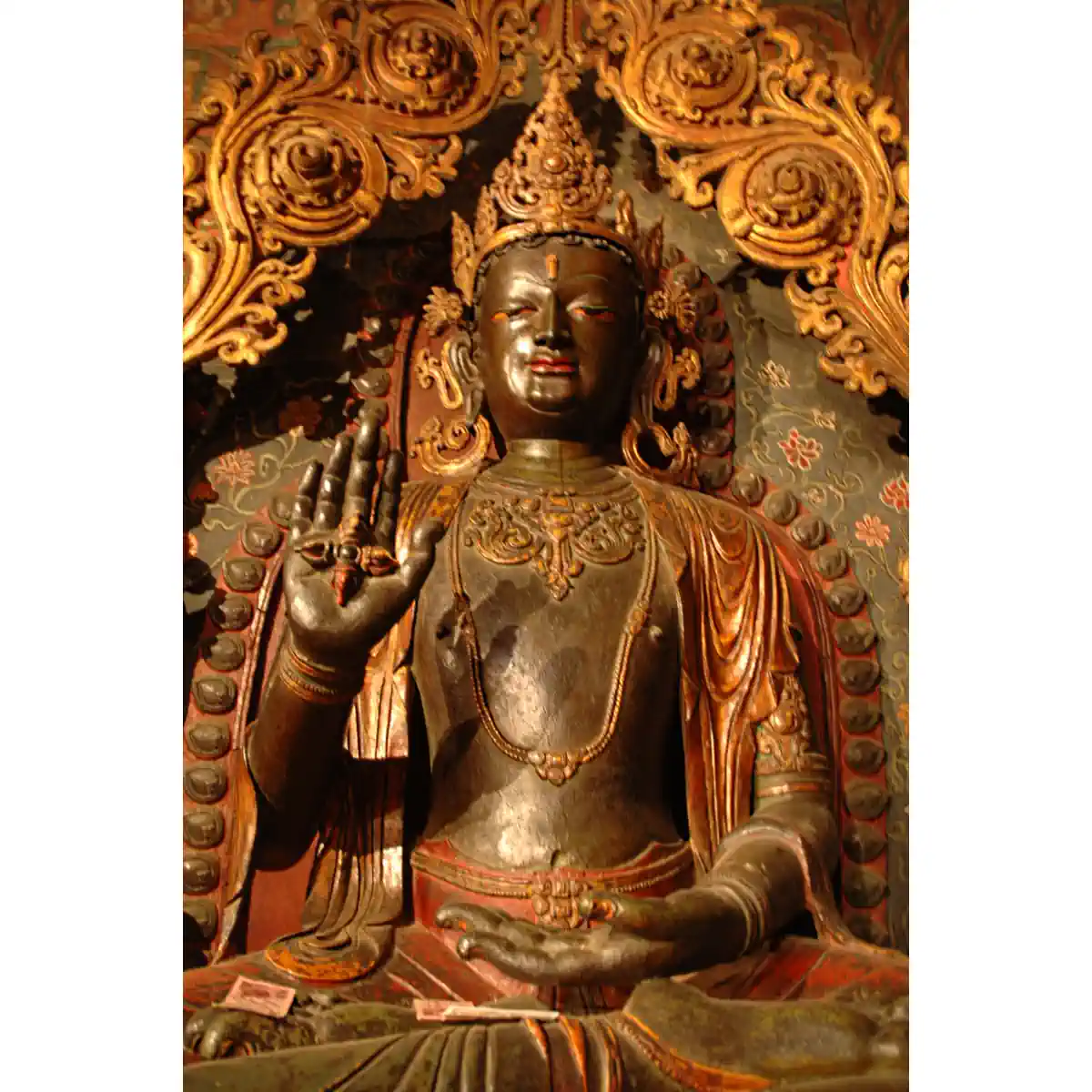
The four jhānas are a defining feature of right concentration in the Buddhist tradition and are part of a set of eight jhāna, right concentration is the ability to focus on only one thing, a good thing, with laser like attention.

Buddha, right concentration and the four jhana.Buddha, right concentration and the four jhana.Buddha, right concentration and the four jhana.Buddha, right concentration and the four jhana.
In Buddhism right concentration achieved via the jhana.

The word jhāna (which is Pali) literally means meditation absorption (the name in Sanskrit is dhyāna), and refers to a set of states of deep and subtle concentration focused on a single object.
Jhāna are states of deep meditative absorption in which the attention is unified with a fixed meditation object, the mind is secluded from sensory distraction, and all unwholesome states are abandoned.
These are part of training the mind and each level of absorption is characterized by a particular cluster of intensifying factors.
There are eight jhānas (listed here are the four material jhana but there are also four immaterial jhāna) and they are eight altered states of consciousness, brought on via concentration, each yielding more concentration than the previous, the two sets when joined together are also called the eight attainments (Atthasamapattiyo).
As you pass through the jhānas, you make your way to deeper and deeper levels of concentration i.e. you become less and less likely to become distracted.
Upon emerging from the jhānas you should have a mind that is not distractible, has diminished awareness of surroundings and where it is therefore able to better focus on the matter at hand.
The jhāna being the cornerstone of right concentration, the eighth factor in the Noble Eightfold Path will help once practices in terms of moving toward freedom from suffering.
The equivalent names for these practices in Chinese and Japanese are Chán and Zen.
In jhāna what we are doing is decreasing our dependence on emotional reactions to external objects by understanding our emotions.
The jhāna are also twofold in that which concentrates upon a mental object intensely (ārammaṇa-upa-ni-jjhāna); and that which examine the characteristic marks or features (lakkhaṇa-upa-ni-jjhāna).

The Four Jhanas

01. Detachment from the external world and a consciousness of joy/rapture and happiness/ease. Paṭhamajjhāna.

In the the first jhana, the five jhana factors i.e. applied thought, sustained thought, rapture (joy), happiness, one pointedness of the mind are gained and are used in order to abandon the hinderances (the jhanangani) i.e. Sloth and torpor, doubt, ill will / aversion, restlessness, greed and sensual desire. (See links below for further details of the five jhana factors and the five hinderances).
This first jhana is pathama jhana , that is, directed thought and evaluation, rapture and pleasure in the unification of the mind.
In the scriptures the first jhana is described as follows: "Quite secluded from sensual pleasures, secluded from unwholesome states, I entered upon and abided in the first jhana, which is accompanied by applied and sustained thought, with rapture and pleasure born of seclusion" (Bhayabherava Sutta, DN 4: trans. Bhikkhu Nanamoli and Bhikkhu Bodhi).
This state is entered from a nonjhanic state, and because it is close to the nonjhanic state, although the mind is brought together, one can return to the nonjhanic state at any time.
This state includes initial and sustained application, continuous efforts to turn toward the counterpart sign (patibhaga-numitta, the object of samatha), which are gross factors, so aim to then dwell in the more tranquil second jhana where these applications will disappear.
In this step remains therein, thoughts, with thought processes, exaltation and well-being engendered by detachment.
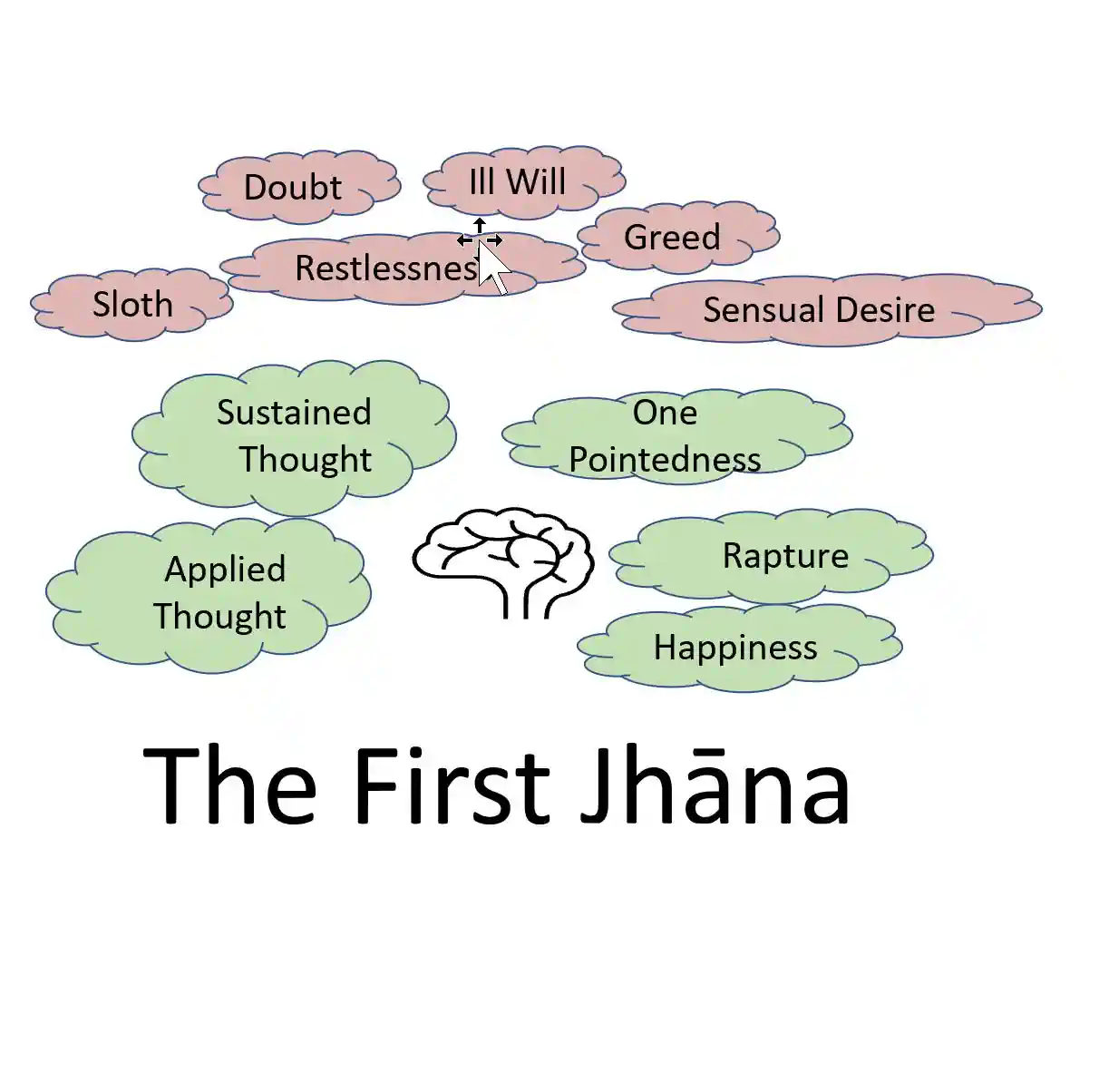
01. Detachment from the external world and a consciousness of joy/rapture and happiness/ease. Paṭhamajjhāna.01. Detachment from the external world and a consciousness of joy/rapture and happiness/ease. Paṭhamajjhāna.01. Detachment from the external world and a consciousness of joy/rapture and happiness/ease. Paṭhamajjhāna.01. Detachment from the external world and a consciousness of joy/rapture and happiness/ease. Paṭhamajjhāna.

02. Concentration, with suppression of reasoning and investigation.

In the second jhana, applied thought and sustained thought (or initial application and sustained application) are abandoned and rapture, happiness and one-pointedness of the mind are gained. This is borne from concentration. Understanding and release of the applied and sustained thought brings relief or ease.
This is dutiya jhana , internal assurance, rapture and pleasure in the unification of the mind.
From the scriptures the second jhana, "With the stilling of applied and sustained thought, I entered upon and abided in the second jhana, which has self confidence and singleness of mind without applied and sustained thought, with [still the] rapture and pleasure born of concentration." (Bhavabherava Sutta, MN 4: trans Bhikkhu Nanamoli and Bhikkhu Bodhi).
In this state the light is brighter and focus more sharp, there is no grasping on the nimitta (concentration) in order to sustain this jhana.
Once the removal of applied though and concentration is achieved from here to the next jhana one needs to concentrate on removing the rapture/joy experienced such that we can enter the third jhana where only ease/happiness and concentration remain. In the next step you should beginning also to understand the difference between joy or rapture and ease or happiness.
In this step one remains therein with inner peace, unification of the mind, without thoughts, without thought processes, with exaltation and well-being engendered by concentration.
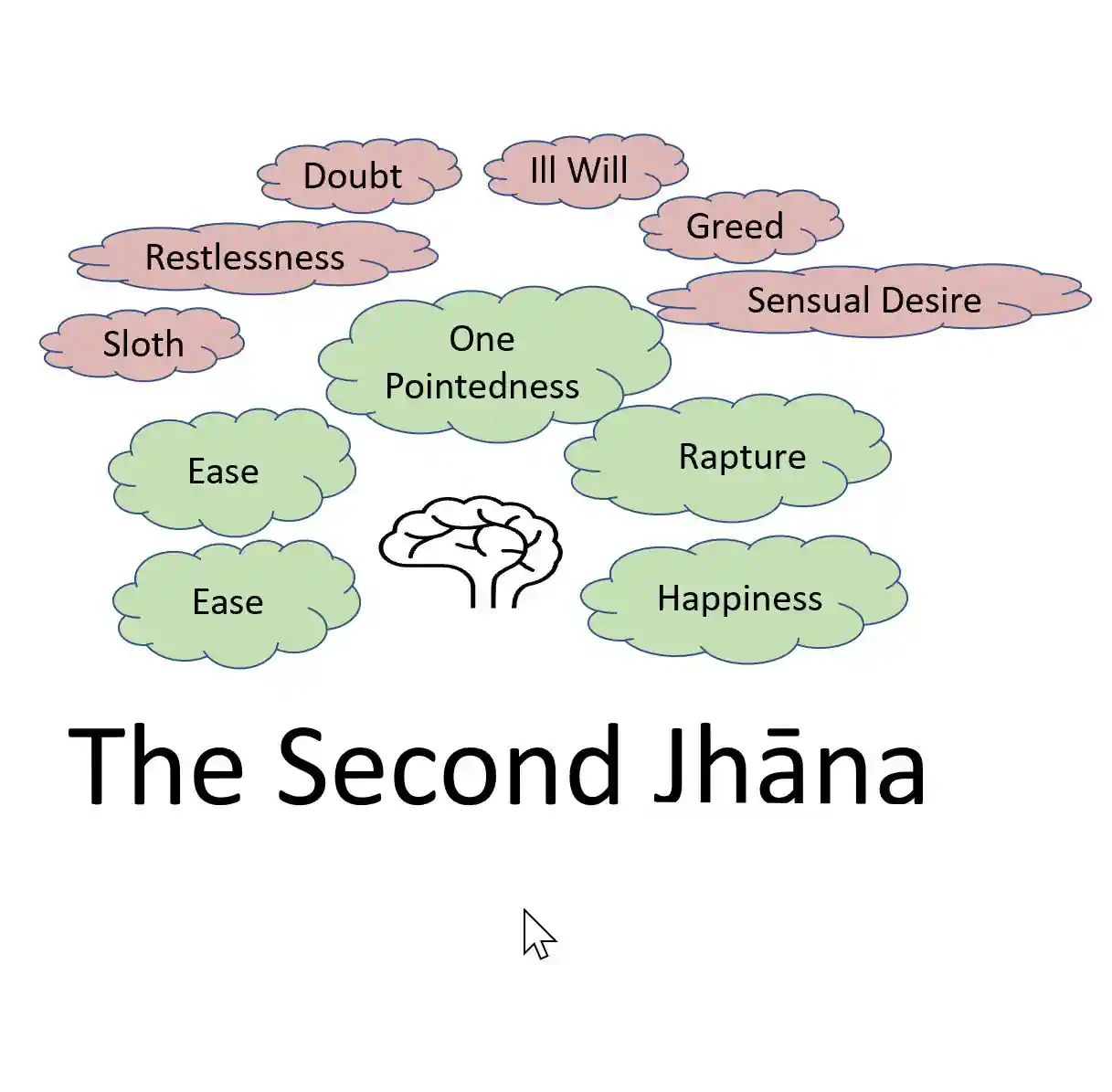
02. Concentration, with suppression of reasoning and investigation.02. Concentration, with suppression of reasoning and investigation.02. Concentration, with suppression of reasoning and investigation.02. Concentration, with suppression of reasoning and investigation.

03. The passing away of joy, with the sense of ease, or happiness remaining.

In the third jhana, rapture is abandoned and subtle ease or happiness and one-pointedness of the mind are gained.
This is tatiya jhana, equanimity, pleasure in the unification of the mind.
In the scriptures the third jhana is expressed as follows: "With the fading away as well as rapture, I abided in equinamity, and mindful and fully aware, still feeling pleasure with the body, I entered upon an abided in the third jhana, on account of which noble ones announce: 'He has a pleasant abiding who has equanimity and is mindful.'" (Bhayabherava Sutta, NM: trans. Bhikkhu Namamoli and Bhikkhu Bodhi).
To move onto the next step once this happiness is understood to be a gross factor, one can start to abandon that to move onto the next step of replacing this ease with stillness.
In this step with the fading away of exaltation, one remains equanimous, mindful and endowed with thorough understanding, and one feels in the body well-being.
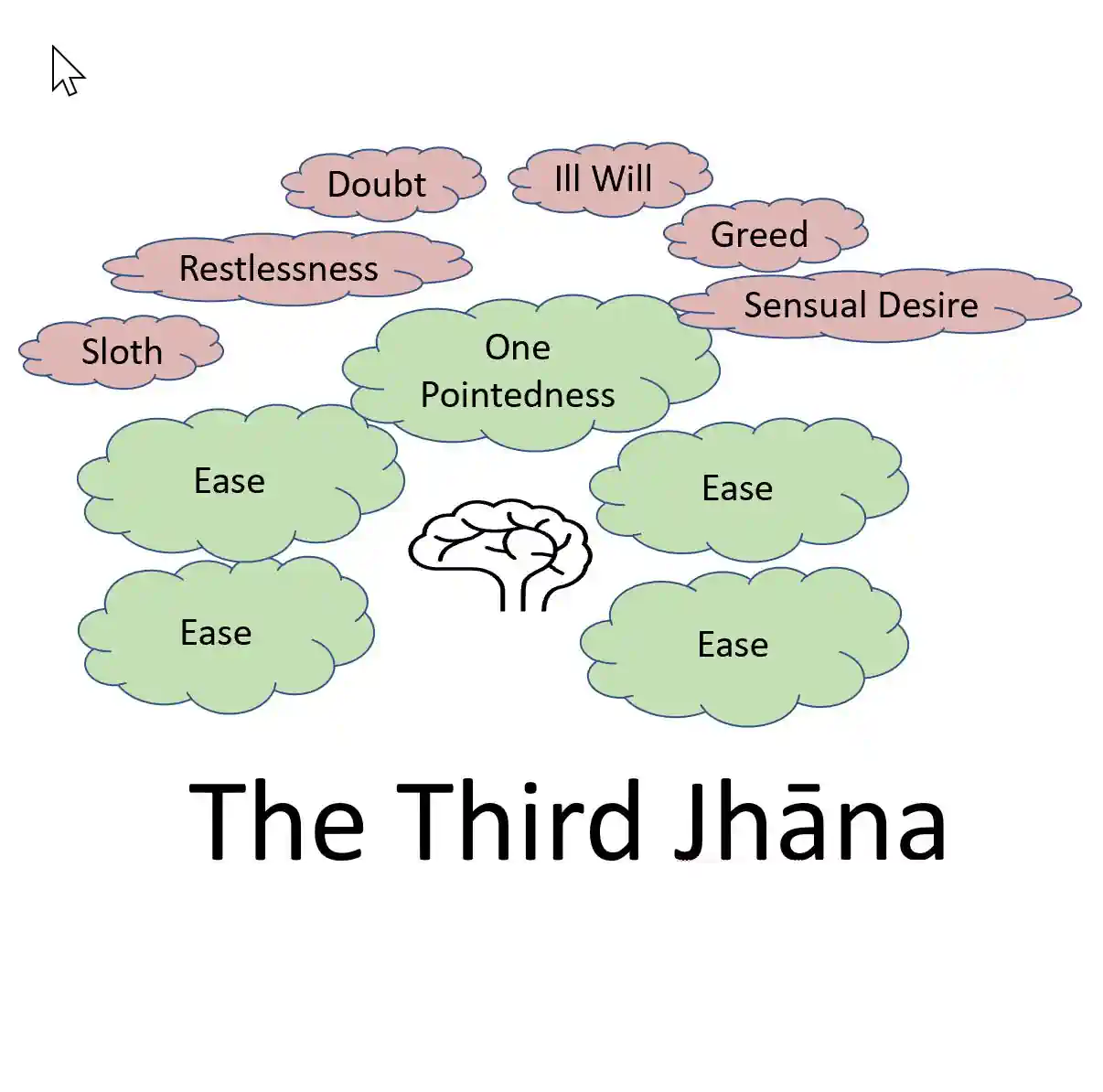
03. The passing away of joy, with the sense of ease, or happiness remaining.03. The passing away of joy, with the sense of ease, or happiness remaining.03. The passing away of joy, with the sense of ease, or happiness remaining.03. The passing away of joy, with the sense of ease, or happiness remaining.

04. The passing away of ease also, bringing about a state of pure self possession, equanimity calm and composure.

In the fourth jhana happiness is abandoned and in its place is gained One-pointedness of the mind and stillness and equanimity. Mindfulness is purified by equanimity.
This is catuttha jhana, complete equanimity with neither pleasure or pain and utter serenity of awareness in the unification of the mind.
"With the abandoning of pleasure and pain, and with previous disappearance of joy and grief, I entered upon an abided in the fourth jhana, which hs neither-pain-nor-pleasure and the purity of mindfulness due to equanimity" (Bhayabherava Sutta, MN 4 trans. Bhikkhu Nanomoli and Bhikku Bodhi).
This final steps is state beyond mental ease and dejectedness (somanassa and domanassa).
Post this step, the mind (citta) concentrated, purified, free of impurities (vigatupakkilese), it can then be directed to seeing by means of insight knowledge (nanna-dassana), understands the body as material and consciousness (vinnana) bound to it.
Then with concentrated mind, he produces a mind-made or psychic body (mano-mayam kayam) and draws that body out of this body. Just as one were to remove a reed from the grass (muiija) sheath, so too from the mind-made body is extracted a perfected mind-made body.
In this step after abandoning pleasantness and abandoning unpleasantness, gladness and affliction having previously disappeared, without unpleasantness nor pleasantness one is purified by mindfulness due to equanimity, and remains therein.
In this jhāna samādhi, there remains only one element, which is pure mental alertness, produced by perfect balance, free from all elements of disturbance. When this state of mind is attained, the meditator who has is not inactive or thinking of nothingness, nor is he in a condition of trance, as is the case in some other systems. In this instance, he becomes increasingly alert, because this concentration has made his mind sharp and keen, purified by the processes of jhāna from sensory defilements, impulses, and emotions. In this condition, the mind becomes suitable and fit to possess powers.
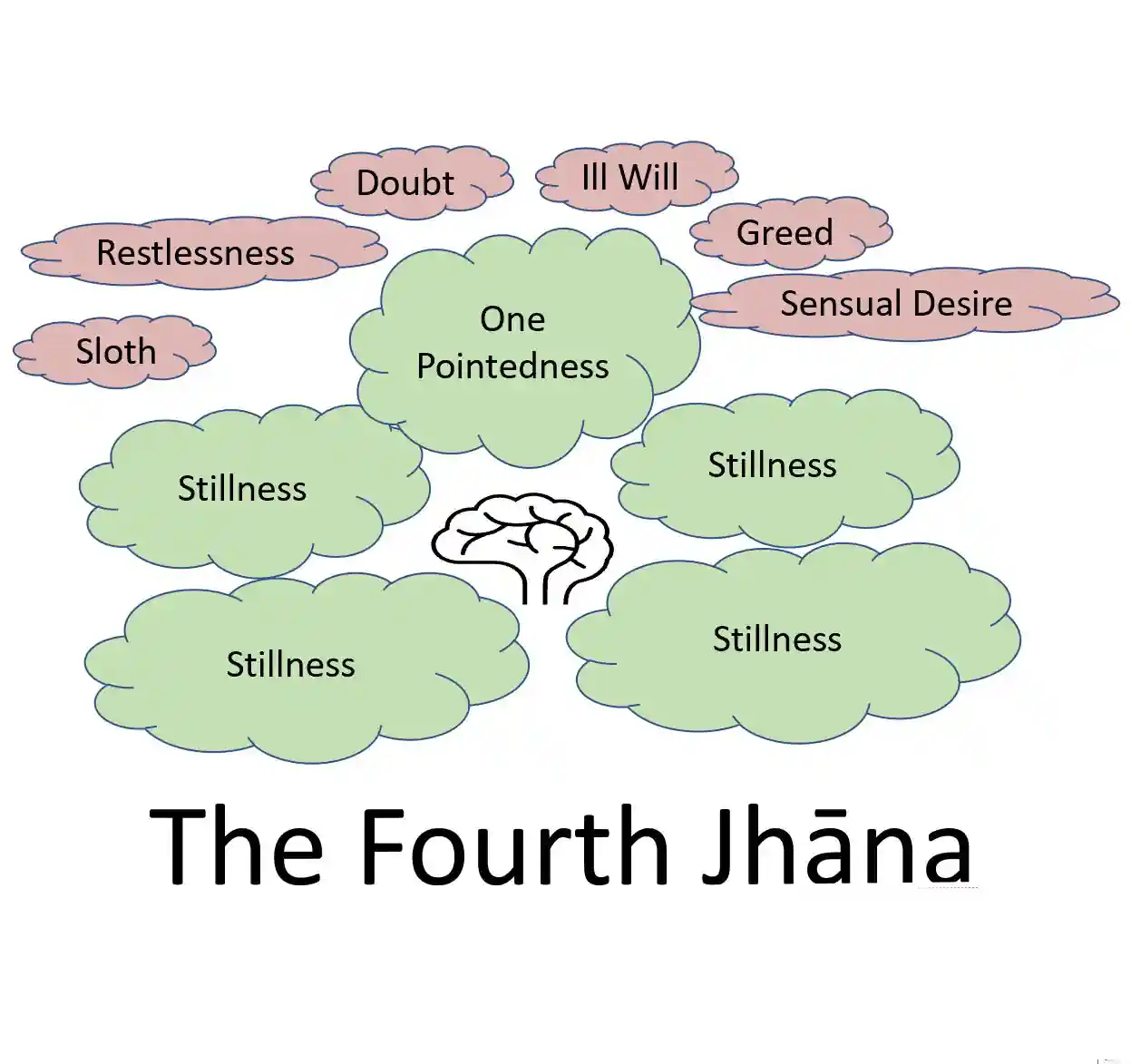
04. The passing away of ease also, bringing about a state of pure self possession, equanimity calm and composure.04. The passing away of ease also, bringing about a state of pure self possession, equanimity calm and composure.04. The passing away of ease also, bringing about a state of pure self possession, equanimity calm and composure.04. The passing away of ease also, bringing about a state of pure self possession, equanimity calm and composure.
Synonyms/tags: the four dhyāna, rupajhana, the four fine-material jhanas


Or, per your interest, look at other related links;

  The five hinderances.
  The five Jhana factors.
  The four immaterial Jhana.
  The eightfold path.

Or, why not search for other related lists on our site;

Or, want to know more? Then more information can be found from external resources at this other website The Four Jhanas.

Or, watch a related video from YouTube by clicking below;


This list was published by Here There, Everywhere and is a printable check-list; To print, hold down the key marked "ctrl", and whilst holding that down, press the "p" key.
This is a downloadable list, select here, if you would like to download the The Four Jhanas - List as an excel or .csv file. Or find the print function on your browser (top right, three dots, print) and print to a pdf printer if you would like to download as a pdf file, or print to a pdf file.

If you are interested in advertising with us reach out via the contact page below. If you would like to share viewers, and your site is related with great content, then feel free to use the code below on your site then reach out via our contact page and we will look for a place to mention you.


Otherwise, suggest improvements, request additional items, report typos, errors or misspellings, ask us questions or just say hello via the comments here below, we are always pleased to hear from you.

Comments History
 htaeApril 22, 2022, 5:19 p.m.
Rating given 5.

Inital review on The four Jhanas checklist.


Note: Current average rating of 5.00 based on 1 reviews and ratings. (1-Low, 5-High)

Note: Comments and ratings help this site get better; if you see something missing, see something wrong, have a question, or want to suggest something to improve then comment below and join the dialogue;

Comments


Looking for something else? Then search the rest of the internet here. If you do like what you see then come back sometime and create your own checklist here. If the item does not have a checkbox next to it, its probably a folder which you can open by clicking. If there are actions listed against an item on the right hand side you can visit websites, download as excel/csv for xls, or create an ical calendar entry.

If you found this page useful, share it, or like us using the buttons on the bottom right, it helps us to improve.

This webpage with information about The Four Jhanas has the following attributes;
The list was authored by .

« Go look for more free lists & checklists